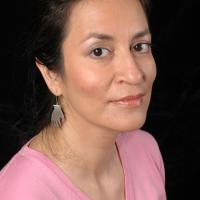
- Jennifer
Dunne
is an
ecologist with interests in computational ecology and ecoinformatics.
She is co-founder of the Pacific Ecoinformatics and Computational
Ecology Lab (PEaCE Lab,
www.foodwebs.org), where she serves as Co-Director. Jennifer is
currently a Research Fellow at the Santa
Fe Institute, and is also a Research Associate at the Rocky Mountain Biological Laboratory .
After receiving a Ph.D. in Energy and Resources from the University of
California, Berkeley (Dec. 2000), she was a National Science Foundation
Postdoctoral Fellow in Biological Informatics at the Romberg Tiburon
Center for Environmental Studies, San Francisco State University, and
was also a Postdoctoral Fellow at the Santa Fe Institute. She has recently co-edited two volumes on
“Ecological Networks” and “Aquatic Food Webs” (see below), and has
written dozens of publications on climate change, food webs, ecological
networks, and ecoinformatics.
- Research Interests: For about a decade, I conducted
experimental and natural gradient field research on how climate change
and microclimate impact and interact with vegetation
dynamics and biogeochemistry in chaparral and subalpine meadow
ecosystems.
Over the last few years, I have shifted into theoretical and
computational
ecology to elucidate and explain general patterns of ecosystem
structure
and function, focusing on networks of predator-prey interactions
expressed
as complex food webs (see image below). I
am using this framework to explore how trophic structure and dynamics
interact to promote ecosystem robustness to perturbations such as
biodiversity loss and invasions, with broader implications for
stability of other types of biotic and abiotic networks. In addition to
working with
contemporary food webs, I am coordinating an interdisciplinary effort
between
ecologists and paleobiologists to construct and analyze detailed
"paleofoodwebs."
We are using these food webs, which extend back more than
500
million
years before present, to look at the evolution of ecosystem structure
through
deep time. We hope to encourage the development of rigorous,
quantitative
paleoecological community studies by other researchers. I am also
collaborating with archaeologists to look at how Aleuts interacted with
the complex, interconnected marine, intertidal, terrestrial, and
freshwater ecosystems of the Sanak Island Archipelago (Aluetian
Islands, Alaska) over the last 6,000 years. My interest in
facilitating
widespread scientific communication and data sharing also motivated my
involvement in two interdisciplinary National Science Foundation
funded projects, "Webs on the Web: Internet Database, Analysis and
Visualization of Ecological Networks" (WoW), and
"Semantic Prototypes
in Research Ecoinformatics" (SPiRE).
My colleagues and I are developing a WWW knowledge base with
integrated ecoinformatics and semantic web tools for biocomplexity
research and education relating to the structure and dynamics of
empirical and model food webs and other ecological networks.
Belgrano, Scharler, Dunne,
& Ulanowicz, eds. Oxford University Press, 2005
Like singing or playing music?
Download scores of song lyrics
and chords in my song books:
Babes (0.8
MB pdf), Dudes
(1.0 MB pdf),
Dead
(0.6
MB pdf)